Print
Print Email
Email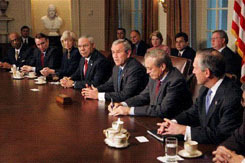
The purpose of the Cabinet is to advise the President on matters relating to the duties of their respective offices.
As the President's closest and most trusted advisors, members of the Cabinet attend weekly meetings with the President. The Constitution does not directly mention a "Cabinet," but the Constitutional authority for a Cabinet is found in Article II, Section 2. The Constitution states that the President "may require the opinion, in writing of the principle officer in each of the executive departments, upon any subject relating to the duties of their respective offices." The Constitution does not say which or how many executive departments should be created.
Who makes up the Cabinet?
The Cabinet traditionally includes the Vice President and the heads of 15 executive departments-the Secretaries of Agriculture, Commerce, Defense, Education, Energy, Health and Human Services, Homeland Security, Housing and Urban Development, Interior, Labor, State, Transportation, Treasury, and Veterans Affairs, and the Attorney General. Cabinet-level rank has also been given to the Administrator of the Environmental Protection Agency; the Director of the Office of Management and Budget; the Director of the National Drug Control Policy; the Assistant to the President for Homeland Security; and the U.S. Trade Representative.
When requested by the President, other officials are asked to attend these weekly meetings including, the President's Chief of Staff, the Director of the Central Intelligence Agency, the Chairman of the Council of Economic Advisors, the Counselor to the President, the Director of the Federal Emergency Management Agency, the Administrator of the Small Business Administration, and the U.S. Representative to the United Nations.
How does one become a member of the Cabinet?
The 15 Secretaries from the executive departments are appointed by the President, and they must be confirmed by a majority vote (51 votes) of the Senate. They cannot be a member of Congress or hold any other elected office. Cabinet appointments are for the duration of the administration, but the President may dismiss any member at any time, without approval of the Senate. In addition, they are expected to resign when a new President takes office.